Project name: Atelier Enclave Design
Atelier Enclave presents the concept of an artistic retreat where creators live and work within the same walls—surrounded by inspiration and the power of art. It evokes an intimate feeling, as if entering a hidden world where art and life quietly merge.
In the search for an environment suited to solitude, creativity, reflection, and collaboration, this space has been designed to support both individual and collective artistic practices. At the same time, maintaining a sustainable relationship with the natural environment has been given equal importance.
COURSE TITLE: DESIGN STUDIO 1
PROJECT: RELIEF
LEVEL 1 TERM 1
COURSE TITLE: SOCIOLOGY
PROJECT: VERNACULAR ARCHITECTURE
LEVEL 1 TERM 1
DEPARTMENT OF ARCHITECTURE
DAFFODIL INTERNATIONAL UNIVERSITY
A glimpse of our 1-1 students semester-end exhibition!
From studio models to freehand sketches, their work captures an inspiring beginning to their architectural journey.
Grateful to our teachers for their support throughout.
Studio Teacher :
Rafid Nahian sir, @Shamim Ahmed sir & Sohanur Rahman pranto, অভিকল্প ২৫৩
Design Studio:VI
Project : Railway Station Design
Batch:231
batch name:নৈঋদ্ধ
Our recent Train Station Design Studio challenged students to reimagine the future of public transportation hubs through architecture that connects, inspires, and serves. These projects explore not only the technical and functional aspects of train stations, but also their role as vibrant public spaces within the urban fabric.
Each design focuses on creating efficient, sustainable, and user-friendly environments—where movement meets meaning. From seamless intermodal connectivity and green infrastructure to inclusive spaces that prioritize accessibility and community interaction, these concepts present fresh perspectives on transit architecture.
Course name : Design studio I
Course teacher :Shamim Ahmed sir and Rafid Nahian sir
Project name : texture conceptual Moodboard
Course name: Sculpture and Model Making.
Project name : Study on famous sculptor
Course Teacher: Nazmul Hoque Nayeem Sir,
Mahmuda Hoque Moon Maam.
Course name : Design studio ||
Course teacher : Esrat Jahan nishi maam & Shohanur rahman sir
Project Name : Parametric Pavilion with 3D Voxel Geometry
Level 1 Term 2
This Parametric Pavilion with 3D Voxel Geometry generated through 3D voxel geometry, creating a dynamic wave-like surface with light and shadow interplay.
Course name : Design Studio II
Course teacher : Esrat Nishi maam & Shohanur Rahman sir
Project name : Exploring emotions through Planes.
Level 1 Term 2
This project is an exploration of human emotions — Happiness, Love, Sadness, and Fear — expressed through abstract forms and colors. Each element is carefully designed to reflect the depth and complexity of these feelings, creating a visual narrative beyond words.
Project :Design of a Gate; Engineering Complex,DIU
Medium: Grey & White PVC.
Course: Sculpture and Model Making.
Level-1, Term-2
This design project focuses on combining security, durability, and aesthetics, ensuring controlled access while complementing the architectural style of the surroundings.We were instructed to work with folding plates and different formations of Rectangle & Triangle.
Our recent High-Rise Design Studio brought together a series of projects that reimagine vertical living for modern cities. Each design explores not only aesthetics but also functionality, sustainability, and how tall buildings interact with their urban context.
From innovative structural systems and energy-efficient façades to community-focused spaces and cutting-edge design languages, these projects represent diverse interpretations of what the high-rise can be in the future.
We’re excited to share this collection of ideas—each one unique, forward-thinking, and rooted in strong architectural principles.
Project Name: Human Ergonomic Space Study
Course Teachers:
1. Mahmuda Haque Moon Ma’am
2. Shovon Das Sir
Project Type: Academic Study & Application in Spatial Design
The Human Ergonomic Space Study is an academic project focused on understanding how human body dimensions, movements, and postures influence the design of spaces and furniture. The study emphasizes the application of ergonomic principles to ensure comfort, efficiency, safety, and accessibility in different functional areas.
Through detailed measurement analysis, anthropometric data, and observation of human activities, the project explores how design decisions—such as furniture sizing, circulation space, and reach zones—can be optimized for diverse users. The outcome aims to guide designers in creating spaces that not only meet functional requirements but also enhance user well-being and productivity.
Course name: Sculpture
Project name: Table Lamp
Level 1, Term 2
students engaged in Project 2: Table Lamp,
This design exercise served as an exploration of the relationship between form, function, and aesthetics, encouraging students to think beyond mere utility. By experimenting with various materials, surface textures, and the interplay of light and shadow, they learned how design decisions affect both ambiance and usability.
The project also emphasized human scale, prompting students to create table lamps that are not only visually compelling but also ergonomically appropriate—demonstrating the balance between artistic expression and practical design.
𝐌𝐚𝐱𝐢𝐦𝐬 𝐨𝐟 𝐊𝐡𝐨𝐧𝐚
𝐂𝐨𝐮𝐫𝐬𝐞 : 𝐀𝐑𝐂𝐇 𝟏𝟎𝟑 | 𝐂𝐥𝐢𝐦𝐚𝐭𝐞 𝐑𝐞𝐬𝐩𝐨𝐧𝐬𝐢𝐯𝐞 𝐀𝐫𝐜𝐡𝐢𝐭𝐞𝐜𝐭𝐮𝐫𝐞
Course Teacher: Esrat Jahan Nishi
To introduce the roots of our vernacular climate-responsive wisdom, students of Level-1, Term-2, explored the Khona’s Maxims, a treasure filled with indigenous knowledge that tells stories of rain, wind, sun, soil, and how our ancestors responded to them with grace and wisdom.
Integrating Khona’s Maxims into the Climate Responsive Architecture course allows students to explore indigenous wisdom rooted in centuries of climatic observation and sustainable living. These age-old sayings offer insights into seasonal changes, agricultural patterns, and passive environmental strategies—elements that directly inform climate-responsive design. Khona’s maxims embody vernacular knowledge systems that guided rural communities in planning their settlements, crop cycles, water usage, and construction activities—all with respect to seasonal and climatic cues. Many of the maxims imply passive design techniques—like orientation, wind movement, thermal comfort, and material usage—which are key to climate-responsive architecture. By interpreting and modeling these maxims, students connect with vernacular knowledge systems, learning how traditional societies lived in harmony with nature—an essential lesson for designing contextually aware, sustainable architecture today.
Course Name: Sociology
Project Name: Vernacular Architecture of Different Regions in the World
Vernacular architecture reflects the social structure, cultural values, and everyday practices of a community. It evolves from local traditions, responding to social roles, family systems, and communal lifestyles, making it a direct expression of a society’s way of life.
Group Project Name: Ziggurat at Ur
Scale: 1:200
Base: 18"/18"
Media: Cardboard,shine board
Course Name: Architecture of Ancient Civilization
The Ziggurat at Ur was a massive stepped temple built around 2100 BCE by King Ur-Nammu, dedicated to the moon god Nanna. It symbolized a bridge between heaven and earth and showcased the religious devotion and political power of the Sumerians. Its impressive architecture reflects the engineering skill and urban planning of ancient Mesopotamia.
Project Name: Greek Architecture Column
Level-1, Term -1
This was a group project where we focused on the three main types of Greek architectural columns: Doric, Ionic, and Corinthian. The model was built at a 1:200 scale, and the primary material used for the project was Plaster of Paris.
Project : Duality of materials
Course : Design studio II
Course teacher: Lamia fariha maam ,
Oishi Nur maam
Level-1 Term-2
Exploring the interplay of contrasting materials, this project investigates how opposing elements—such as texture, weight, and transparency—can coexist in architectural design. The concept of duality highlights the balance and tension between the raw and refined, creating a harmonious dialogue that enhances the built environment.
"MODULAR VERTICAL GARDEN CITY"
Course:Landscape(Arch-406)
course teacher: Esrat Nishi maam
Level-3, Term-1
Modular Vertical Gardening System with individual Steel Stands is a space-saving, sustainable solution designed for urban environments. The system features sleek, weather-resistant steel stands that support multiple tiers of plants, ideal for balconies, rooftops, or small outdoor areas. It's modular design allows easy customization, mobility, and scalability based on user needs. Each unit ensures proper drainage, structural stability and optional add-ons like irrigation or grow lights. This project promotes greener living and encourages home-based food or ornamental gardening in compact spaces.
This project helps students develop creative and practical skills in sustainable urban gardening through design, engineering, and horticulture. They gain hands-on experience with materials, plant care and modular construction. It also builds teamwork, project planning and environmental awareness.
বৈশাখ পার্বণ ১৪৩২
বাংলার ঐতিহ্য, রঙ, আর সৃজনশীলতায় বরণ করে নিই নতুন বছরকে।
ড্যাফোডিল স্হাপত্য বিভাগ এর পক্ষ থেকে সবাইকে জানাই
শুভ নববর্ষ ১৪৩২–এর আন্তরিক শুভেচ্ছা ও ভালোবাসা।
নতুন বছরের আগমনী বার্তায় রঙে রাঙিয়ে উঠেছে স্হাপত্যবিভাগ।
তুলির টানে বাঙালিয়ানার ঐতিহ্য, রঙের ছোঁয়ায় সংস্কৃতির গল্প—সব মিলিয়ে তৈরি হচ্ছে এক অন্যরকম বৈশাখের আবহ।
ক্যাম্পাসজুড়ে ছড়িয়ে পড়েছে উৎসবের প্রাণ—আসুন, একসাথে উদ্যাপন করি বৈশাখের রঙিন আনন্দ।


স্টুডিও : (১.১)
প্রযেক্ট : নববর্ষ পোস্টার!
স্টুডিও টিচার : Sheikh Muhammad Rezwan sir & Rafid Nahian sir..
Design of an "OASIS MOSQUE "
Course- Design Studio- V
Project -2
Course Teacher - Asif Turza sir &
'Exploring the idea of the mosque as a monumental space, experimenting with different forms to create a strong architectural presence.Also emphasized spirituality, symbolism, and community engagement while reinterpreting traditional elements in contemporary ways.'
Design of an "OASIS MOSQUE "
Course- Design Studio- V
Project -2
Course Teacher - Asif Turza sir &
'Exploring the idea of the mosque as a monumental space, experimenting with different forms to create a strong architectural presence.Also emphasized spirituality, symbolism, and community engagement while reinterpreting traditional elements in contemporary ways.'
Project -1
"Institute for Architects"
Level 3 term 1
Course: Design Studio V
(Space, Form & Function)
Course teacher - Asif Turza sir &
Oishi Nur maam
An innovative Institute for Architects! Blending creativity with functionality, creating spaces that inspire innovation and collaboration through unique and inspiring forms.
বর্ণ থেকে ত্রিমাত্রিক আচ্ছাদন :
ছাত্রছাত্রীদের এই কাজটি ভাস্কর্য ক্লাসে দেয়া হয় ত্রিমাত্রিক ক্ষেত্রে কাজের অভিজ্ঞতা অর্জন এর জন্য। তারা একেকজন একেক টি বাংলা বর্ণ পছন্দ করে তার থেকে আচ্ছাদন বানায়।
বর্ণ থেকে যদি দারুণ কিছু হয় তবে বর্ণ ই ভাল।
মহান ভাষা দিবসে ছোট নিবেদন আমাদের পক্ষ থেকে।
শিক্ষক : নাজমুল হক নাঈম ,ঐশি নূর
RED (july movement)
Course: HUM 106
Level-1 Term-2
Project: Say "No" to War.
Course Teachers: Nazmul Haque Nayeem
Any war brings darkness and sufferings to the world and mankind. In this project, students were asked to make a sculpture with a concept that gives a message Against war

Project : Model making
Course:Sculpture and model making
Course Teacher: Nazmul Haque Nayeem
Students were asked to remake a architectural model by selecting some case studies. Main aim was to become proficient in making architectural models. They were given freedom to choose any kind of architectural model that opens scope to explore boundaries of model making.

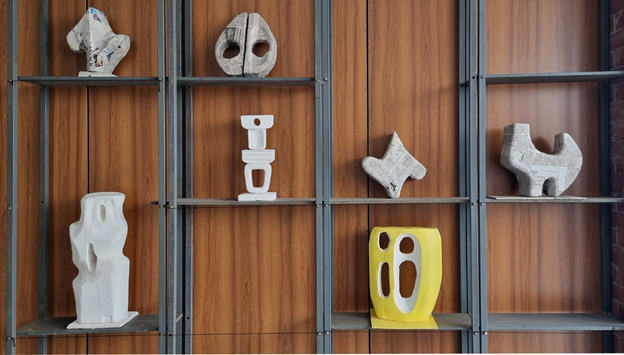
Project: Revisiting Henry Moore and Barbara Hepworth
Course: Sculpture and model making
Batch: L-1,T-2
Tutor: Nazmul Hoque Nayeem
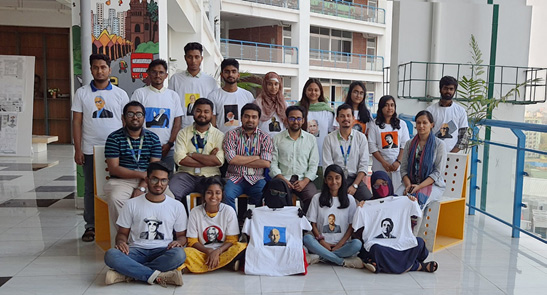
Project Title: Knowing the Architects: T-shirt Design
It’s inspirational to know some impactful characters to start the journey of architecture. Level-1 Term-1 Students of the Department of Architecture at DIU have studied renowned architects around the world and expressed them in their studio project of T-Shirt Design. They explored brush painting, fabric color, and digital media to show off their craftsmanship.
Course Tutor: Shafiul Islam Rajib
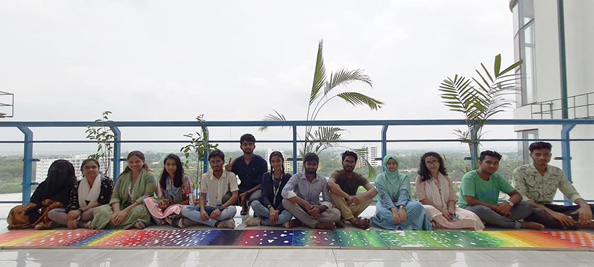
Project title: Progression of Color
In this project, the students of Level-1, Term-I have explored the "Color Wheel" to understand the basics of color. Students have spontaneously chosen a geometric pattern to fill with color. They have synchronized the color of one’s tile with the color of adjacent one, creating a seamless progression.
Course Tutor: Shafiul Islam Rajib
Project title: Virology research center.
Student name: Mahmuda Akter
Can we think of a research center that may deal with virus-related issues (like Covid)? Our student Mahmuda Akter thinks of a center like this in her thesis.
Animation of the Project Link
Project title: Resuscitation of Mawa Ghat
Student name: Yeasmin Akter
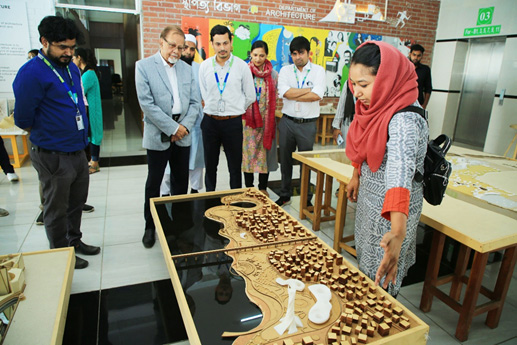
What will be the future of the new city along the Padma Bridge and Mawa Ghat? Will it be an urban hub for the next generation?
Our student Yeasmin Akter Ranu tried to assemble some ideas in her thesis project for the future expansion of Metro city towards the southern part of Dhaka.
Animation of the Project link
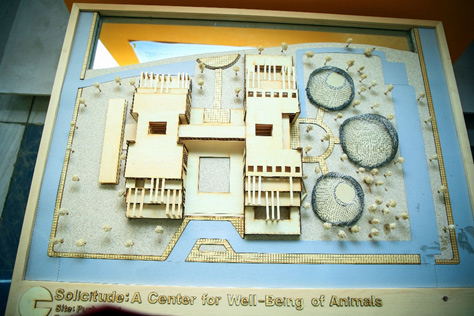
Project Title: Solitude: A Center for Well-being of Animals
Nowadays so many people adopt and raise pets as their family members. What about a center for Pet animals where animal lovers can come and get facilities like socialization, sharing common interests/thoughts, amusement, food, health care etc. for their pets? Our Alumni Matrin Mozammel thought about such a center in her thesis. Have a look at the visualization of that project.
Animation of the Project Link
Project Title: Land Port at India-Bangladesh border in Sylhet
Land Ports also called border stations for import and export. A land port houses the customs and border protection, and other inspection agencies responsible for the enforcement of country's laws pertaining to such activities. The land port of entry consists of the land, the buildings, and the on-site roadways and parking lots that the port of entry occupies. The facility serves as a point of contact for travelers entering or leaving the country for the purposes of enforcement; Prevention of illegal aliens from entering the country; Collection of revenues; Prevention of injurious plants, animal pests, human and animal diseases from entering the country. Bangladesh has 2400 km land border, 92% of which is with India and 8% is with Myanmar, Bangladesh border trade is looked after by 181 land customs stations. Check the thesis project of our student Maliha Hossain at India-Bangladesh Border in Sylhet.
Animation of the Project
Project Title: Jibonanondo Dash Memorial Complex
Creating exploratory spaces is a challenging task, as a student needs to have a sound knowledge of how a space can communicate its purpose with its users. Pronab Chandra Halder designed a Jibanananda Das Memorial and Research Center, where the spaces tried to depict different phases of the great poet, based on his philosophy. The poems of the poet inspired him to design exploratory spaces, where one can relate himself with the space as if, the spaces are telling stories.
Project Animation Video
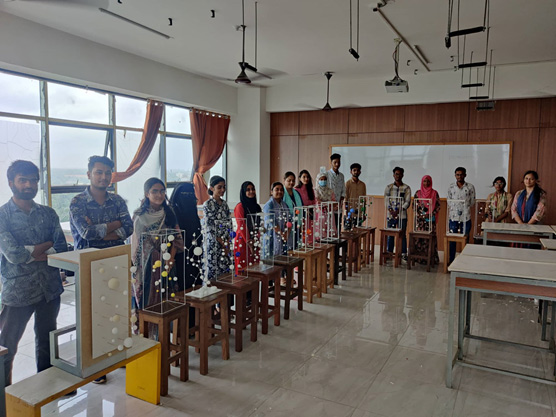
Project Title: Dots in Space
The dot marks a position in space. Being the prime element in the vocabulary of basic design conceptually it has no length, width, or depth and therefore static, centralized, and directionless. Although theoretically, a dot has neither shape nor form, it begins to make its presence felt when placed within a visual field with some degree of visual dimension. In this particular project students are asked to make a composition with dots.
Course Tutor: Lamiya Fariha